


 |
ULTRAVIOLET (UV) LIGHT is electromagnetic radiation with a wavelength shorter than that of visible light, but longer than X-rays, that is - in the range between 10 and 400 Nm corresponding to photon energies from 3eV to 124eV. |
It is so named because the spectrum consists of electromagnetic waves with frequencies higher than those that humans identify as color violet. These frequencies are invisible to humans, but near UV is visible to a number of insects and birds.
☛ See CURIOUS FACTS and GALLERY below......

UV light is found in sunlight and is emitted by electric arcs and specialized lights, such as mercury lamps and black lights. It can cause chemical reactions, and causes many substances to glow or fluoresce. A large fraction of UV, including all that reaches the surface of the Earth, is classified as non-ionizing radiation.
However, the entire spectrum of ultraviolet radiation has some of the biological features of ionizing radiation, in doing far more damage to many molecules in biological systems than is accounted for by simple heating effects (good example is sunburn).
These properties derive from the UV photon's power to alter chemical bonds in molecules, even without having enough energy to ionize atoms.
Although ultraviolet radiation is invisible to the human eye, most people are aware of the effects of UV on the skin, called suntan and sunburn. Short-wavelength and mid-wavelength UV can cause much damage to living organisms, such that life on Earth outside of the deep oceans is possible only because the atmosphere, primarily the ozone layer, filters out nearly all short-wavelength and most mid-range UV.
A small amount of near-ultraviolet reaches the surface and does not cause sunburn, but is still capable of causing long-term skin damage and cancer. A smaller amount of UV reaches the surface and is responsible for sunburn and also the formation of vitamin D in organisms that make this vitamin (including humans).
The UV spectrum thus has many effects - both beneficial and damaging - to human health. The Sun's emission in the lowest UV bands, the UVA, UVB, and UVC bands, are of interest, as these are the UV bands commonly encountered from artificial sources on Earth.
The shorter bands of UVC, as well as even more energetic radiation as produced by the Sun, generate the ozone in the ozone layer when single oxygen atoms produced by UV photolysis of dioxygen react with more dioxygen.
The ozone layer is especially important in blocking UVB and part of UVC, since the shortest wavelengths of UVC (and those even shorter) are blocked by ordinary air. Of the ultraviolet radiation that reaches the Earth's surface, up to 95% is UVA (the very longest wave- length) depending on cloud cover and atmospheric conditions.
SUNGLASSES AND UV-PROTECTION
Generally sunglasses are designed to protect your eyes from strong sunlight. In bright light the pupil of the human eye is shrinking, and vice versa - in low expand. This is a normal reflex of the eye postigane focus and better viewing of items mechanism today widely used in photography, for example.
Today's sunglasses are designed to capture / reflect these harmful rays, which are invisible to the naked eye, but reach us - even in cloudy weather when we think that seemingly no sun. This is achieved by applying filtration layers on eye/sun glasses that stop those rays. Reputable companies even put stickers in windows/lenses indicating 100% UV protection, and some even incorporate these inscriptions inside the glass (Chanel, Dolce & Gabbana, Carrera, and many others).
Optical corrective lenses by the higher indices (1.56 ... 1.74) and contact lenses also have such protection, although they're transparent/colorless.
The most common manifestation of ultraviolet rays is the sunburn they cause on the skin. However, the ultraviolet spectrum has many other effects, both beneficial and harmful, for human health.

● The ozone layer is particularly important in blocking UVB and some UVC radiation because the shortest wavelengths in the UVC range (as well as those even shorter) are blocked by ordinary air. Ordinary glass is partially transparent to UVA but is opaque to shorter wavelengths, whereas silica or quartz glass, depending on quality, can be transparent even to vacuum UV wavelengths. Ordinary window glass passes about 90% of the light above 350 nm, but blocks over 90% of the light below 300 nm.
● Of the sun's emissions in the lowest UV bands, the ones of interest to us are the UVA, UVB, and UVC bands, which are the most common from man-made sources on Earth. Shorter UVC bonds, as well as even more energetic radiation, are produced by the Sun, generating the ozone in the ozone layer when singlet oxygen atoms produced by UV photolysis of the dioxide react with the higher dioxide.
● Of the ultraviolet radiation that reaches the Earth's surface, up to 95% is UVA (the longest wavelength), depending on cloud cover and atmospheric conditions.

IS THERE A HEALTH RISK IF WE BUY SUNGLASSES FROM RANDOM SOURCES?
IN ONE WORD - SERIOUS! Some people, misled by the lower prices, buy sunglasses not from optical stores, but from a variety of sources: markets, street "traders", etc. When we put sunglasses on our face (generally with dark lenses), they actually are a filter for the eye - the pupil automatically dilates to let in more light in order to better see the object. If the glasses do not have the appropriate UV protection, this means that a greater flow of the above harmful and invisible rays will enter the eyes directly! A number of complications can result from this, including damage to the retina, macula and other major components of the eye.
TIP #1: When buying sunglasses from random sources, get them UV-tested as quickly as possible. All normal optical stores have such devices, and this service, naturally, you should pay.
TIP #2: Then add the price of the test to that of the sunglasses already purchased. At this point you will realize that 99% of these glasses fail the UV test!
TIP #3: Buy sunglasses ONLY from reputable optical stores, where you'll get a 100% guarantee of origin and quality.
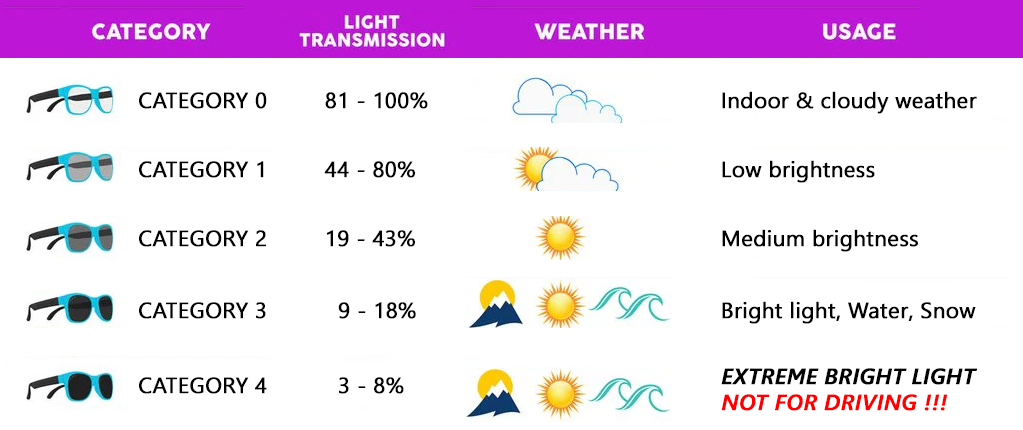
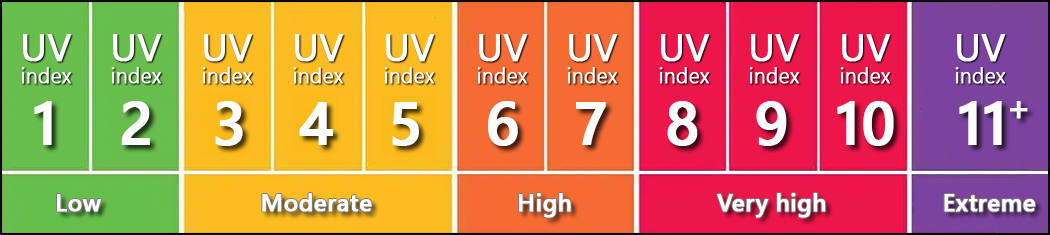
THERE ARE TWO STANDARDS FOR THE DEGREE OF TINTING IN SUNGLASSES' LENSES... | |
|---|---|
EUROPEAN STANDARD EN 1836:2005 (By category) |
WORLD HEALTH ORGANIZATION (By index) |
|
THESE CATEGORIES ARE MORE USED BY SUNGLASSES MANUFACTURERS. |
THESE INDICES ARE MORE USED IN WEATHER FORECASTS BY METEOROLOGICAL SERVICES. |

CURIOUS FACTS 
- Our eye is a great creation of nature, but actually only transfers encoded information from the senses (sight, taste, smell, sound) to the brain. And the brain is the organ that collects /accumulates this information and process it in milliseconds. Thus we get stereo vision, so called 3D (three-dimensional) images. In fact we see through the brain, and eyes are only its receptors of light waves!
- Some animals such as birds, reptiles and insects (e.g. bees), see the near-UV part of the spectrum. Many fruits, flowers and seeds differ brighter in ultraviolet than in the scope of human vision. Scorpions glow or take a yellow or green color under the influence of UV rays.
- Many species of birds have patterns in feathers, which can be observed only in the ultraviolet, and urine and other body fluids of some animals, including human, stand out more easily when illuminated with UV rays.
These special properties of ultraviolet light today are widely applied in criminology. For example ▼


COMPARATIVE PHOTOS
HOW APPLICATION OF ULTRAVIOLET (UV) AND OTHER FILTERS SIGNIFICANTLY RISES PHOTOGRAPHIC ART, THUS COMPENSATING DISADVANTAGES OF OUR HUMAN EYES...



